
Concern · Camden Medical Centre, Orchard
Face Concerns: Jawline Contouring, Lifting and Lines
The face changes over time through ageing, muscle activity, volume loss and skin laxity, which can affect its balance, definition and expression. Line Aesthetics Clinic treats these changes without surgery: a square jaw, jowls, a soft jawline, laugh and marionette lines, temple hollows, asymmetry and general age-related change. Each plan is set by Dr Ram Nath, founder and lead aesthetic physician, using botulinum injections, fillers, collagen stimulators, thread lifts or skin tightening, with the aim of a natural look.
 Medically reviewed by Dr Ram Nath · Updated October 2026

What causes a square jaw, and how can it be slimmed without surgery?
A square or wide jaw is commonly caused by an enlarged masseter muscle, the muscle used for chewing and clenching. Botulinum injections into the masseter can slim and reshape the jawline without surgery, giving a softer, more V-shaped lower face.
Botulinum injections are not only for smoothing wrinkles. Many people, especially women, look for a softer, more tapered face shape, and reducing the bulk of the masseter is one way to achieve it. This is part of our lifting and shaping treatments.
How masseter injections work
Targeted injection
The masseter muscle, at the angle of the jaw, is carefully targeted with botulinum.
The muscle relaxes and reduces
The injection relaxes the muscle, which gradually reduces in size through disuse, a process known as muscle atrophy.
Gradual slimming
Over four to six weeks, the jawline appears slimmer and more contoured. Results typically last four to six months, and some people see the effect for up to a year.
What happens at your consultation
Dr Ram Nath will assess your facial anatomy, check whether masseter enlargement (masseter hypertrophy) is the cause of your square jaw, discuss your goals and create a tailored plan. If the muscle is not the main cause of jaw width, he may recommend other contouring treatments that suit you better.
- Minimally invasive, with no cutting or surgery
- Most people return to normal activities straight away
- Results appear gradually and look natural
- Can improve the overall proportion of the face
What causes lower face laxity, or jowls?
Jowls are the sagging of skin and tissue along and below the jawline, caused by natural ageing changes in the skin, fat, muscle and bone. They reduce definition in the lower face and neck and can make you look older or more tired than you feel.
Loss of collagen and elastin
These proteins give skin its structure and elasticity. As they decline, the skin sags.
Decreased facial volume
Fat pads in the cheeks shift downward with age and pull the skin with them.
Muscle and fascia weakening
The SMAS layer (superficial musculoaponeurotic system), which supports facial structure, becomes lax over time.
Bone resorption
The jawbone and facial bones shrink with age, giving less support to the soft tissues.
Gravity
Over time, gravity pulls down on the skin and adds to sagging.
Lifestyle factors
Smoking, sun exposure, poor diet and a lack of skincare can speed up ageing.
Treatments for jowls
A thread lift places fine, dissolvable PDO or PLLA threads beneath the skin to lift and reposition sagging tissue in the cheeks, jawline and neck, and stimulates collagen as the threads dissolve. It takes about 15 to 45 minutes under local anaesthetic, and most people return to normal activities within a few days.
Hyaluronic acid dermal fillers restore lost volume in the cheeks and jawline for a firmer, more defined lower face. Botulinum injections for a lower face and jawline lift relax the downward-pulling muscles, and Ultraformer HIFU or Density by Jeisys can tighten mild jowls without needles.
Is a thread lift right for you?
A thread lift suits men and women with mild to moderate sagging in the lower face and early signs of ageing, usually from their late 30s to early 50s, who want a refreshed look without surgery. The threads are placed through tiny entry points, you stay awake and can give input during the procedure, and once in place the threads sit hidden beneath the skin.

“Our goal is not to change how you look, but to reveal your most confident, natural self.”
Dr Ram Nath, founder and lead aesthetic physician
What causes a poorly defined jawline?
A poorly defined jawline is one where the natural contour of the lower jaw is not clearly visible, often because of genetics, ageing, weight changes or posture. It is completely natural, but it can make the face look softer and rounder and blur the line between face and neck.
Common causes
- GeneticsSome people naturally have a less prominent lower jaw or a rounder face shape.
- Loss of collagen and elastinSkin loses firmness over time and begins to sag.
- JowlsAge-related tissue descent softens the edge of the jawline.
- Bone resorptionBone density in the jaw may reduce with age, leaving less support for the tissues above.
- Weight changesWeight gain can add fat to the lower face and neck and mask the jawline, while rapid weight loss may leave sagging skin.
- Posture and muscle toneA forward head posture and weak facial and neck muscles can contribute to a less defined jawline over time.
Non-surgical treatments for jawline definition
Hyaluronic acid fillers can add volume to the jawline and chin, improve structure and contour, and create a more defined, angular profile. Semi-permanent fillers are another option for sculpting the jawline.
Botulinum injections can relax overactive jaw and neck muscles such as the platysma bands, reduce muscle bulk and smooth wrinkles, and slim the face when injected into the masseter muscles.
Non-surgical jawline treatment may suit you if you have mild to moderate sagging or jowls, notice fullness or softness around the lower face, or want a more sculpted contour with little downtime. Dr Ram will recommend the option that fits your facial structure.
What causes laugh lines and marionette lines?
Laugh lines and marionette lines deepen with age as the mid and lower face lose volume, collagen and elasticity, and as repeated expressions and gravity add to the creases. They are a natural part of facial ageing, and non-surgical treatments can soften them.
Laugh lines (nasolabial folds)
These creases run from the sides of the nose to the corners of the mouth. They become deeper with age and with repeated expressions such as smiling and laughing. Causes include reduced volume in the mid-face and cheeks, natural facial movement, loss of collagen and elastin, and skin laxity from ageing and gravity.
Marionette lines
Marionette lines run from the corners of the mouth down to the chin and can give a downturned or frowning look even when you are not sad. Causes include loss of skin elasticity and volume, age-related bone and fat resorption, gravity acting on weakened tissue, and overactive muscles around the mouth and chin.
What causes temple hollows, and how can the forehead be shaped?
Hollow temples and a flat forehead come from volume loss through ageing, weight loss or genetics, and can make the upper face look tired and out of balance. Temple and forehead fillers restore volume and refine the contour of the upper face without surgery.
Temple fillers
Temple fillers correct sunken or hollow temples. They restore volume, soften the transition between the forehead and cheeks, and can subtly lift and support the outer brow and cheek area, improving upper-face balance. Hyaluronic acid fillers are commonly used because they integrate smoothly with tissue and can be reversed. Filler is placed with a fine needle or cannula in a quick in-clinic treatment, and most people return to normal activities the same day.
Forehead fillers
Forehead fillers add volume, soften deep horizontal forehead lines and improve the projection and curvature of a naturally flat forehead, helping the forehead, nose and chin sit in better proportion. Hyaluronic acid fillers are used, and collagen stimulators or calcium hydroxylapatite may be considered for longer-term volume where suitable.
Important considerations
The forehead and temples have particular anatomical features, so treatment needs a qualified doctor with a detailed knowledge of facial anatomy. The approach depends on your anatomy, goals and age-related changes, and your plan is set after assessment. Treatment is carried out by Dr Ram Nath or a doctor he has trained.
What is facial asymmetry, and what is facial balancing?
Facial asymmetry is when one side of the face differs from the other, and most people have some degree of it. Facial balancing is a non-surgical treatment plan that improves proportion and corrects more noticeable asymmetry, aiming for a natural, balanced result rather than perfection.
Differences between the two sides can affect:
- EyesOne eye may look smaller or more open
- EyebrowsOne brow may sit higher than the other
- CheeksUneven volume or shape
- Jawline and chinDifferences in chin projection or jaw contour
- NoseA crooked or deviated nose
What causes facial asymmetry?
Your inherited facial structure plays a key role. Ageing adds loss of collagen, bone density and facial volume. Past facial injuries can cause lasting shifts in bone and soft tissue, habits such as sleeping on one side or chewing on one side can contribute, and overdeveloped or underused muscles can distort symmetry.
How facial balancing is done
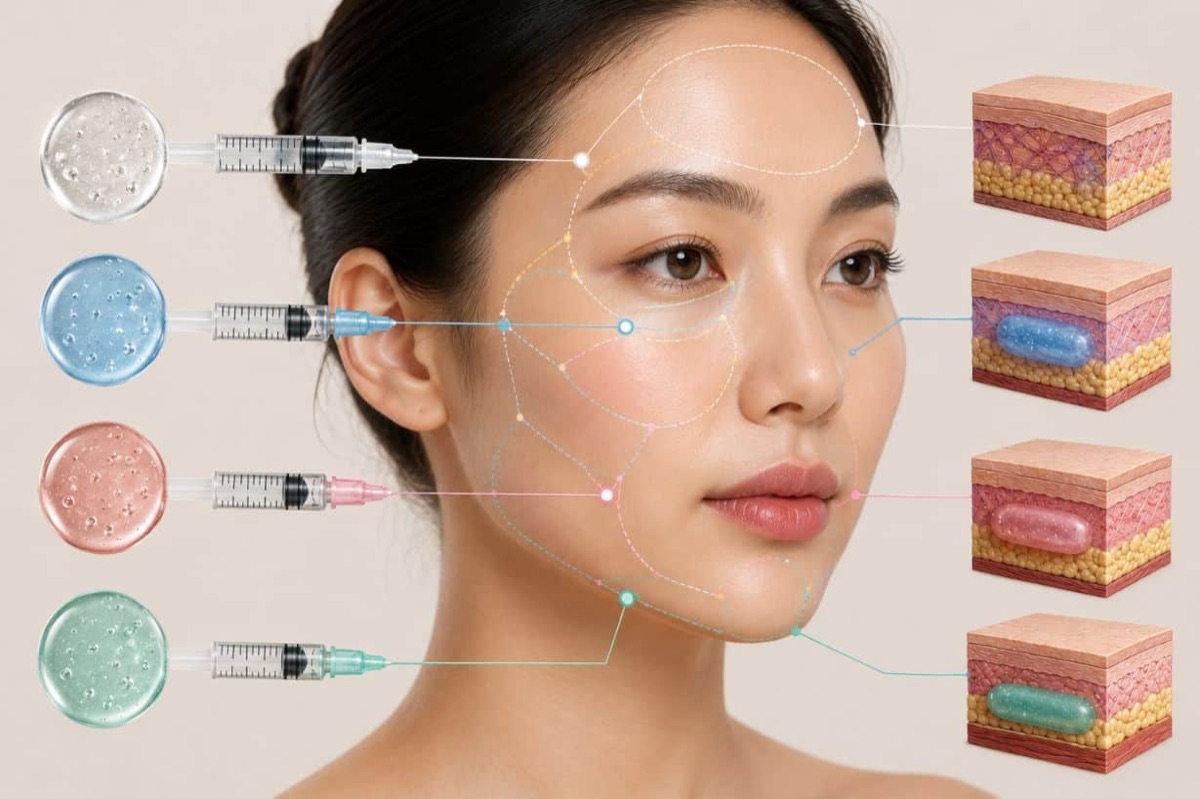
Dermal fillers restore volume where it is lacking, such as the cheeks, temples, chin, jawline and under-eye area. Botulinum injections relax overactive muscles, correct muscle dominance in the jaw or brow, and subtly lift or reshape features. Depending on your needs, a thread lift to reposition sagging tissue, collagen stimulators to build structure over time, or skin tightening with Ultraformer HIFU may be added.
Facial balancing is not one-size-fits-all. At consultation, Dr Ram assesses your facial anatomy, identifies asymmetry and volume loss, and builds a plan around your goals. The aim is to refine your features while you still look like yourself.
How does the face change with age?
The face changes with age through three processes: deflation, deterioration and descent. Bone and fat volume reduce, the skin becomes thinner and less elastic, and tissue shifts downward, so a narrower lower face gradually becomes squarer.
- 1Bone and cheek fat volume reduce
- 2Skin thins, with spots and fine lines
- 3Fat descends and the lower face squares
Non-surgical treatment options
- Volume enhancement lift (liquid facelift): a targeted filler technique, including collagen stimulators, that restores volume and structure. It can address brow lines, smile lines, marionette lines, jowls and lip volume loss, and improve cheek and chin definition. How long results last depends on the products used, and mobile areas may need touch-ups.
- Soft Lift: a single-session technique combining botulinum injections and dermal fillers to smooth expression lines, fill wrinkles, restore volume in hollow areas and visually lift sagging skin. Areas include the brows, forehead, under-eye hollows, crow’s feet, cheeks, smile lines, lips, marionette lines and jawline.
- Botulinum injections for lines and wrinkles and for lifting and shaping.
- Hyaluronic acid and semi-permanent fillers to restore volume and contour.
- Non-surgical thread lift for early to moderate sagging of the cheeks, jawline and neck, using dissolvable threads placed under local anaesthetic.
Your plan is set by Dr Ram Nath, founder and lead aesthetic physician, based on your needs, medical history and the result you want, and treatment is carried out by Dr Ram Nath or a doctor he has trained. Thread lifts are performed by Dr Ram Nath himself.
Deflation
The underlying bone structure gradually reduces and shifts, and facial fat pads, especially in the cheeks, shrink.
Deterioration
Skin becomes thinner, drier and less elastic. Sun exposure adds brown spots, visible veins and enlarged pores, and dead cells shed less efficiently, leaving uneven texture and dullness.
Descent
Fat in the cheeks and lower face moves downward, loss of elasticity creates folds such as nasolabial folds and marionette lines, and the “triangle of youth” changes into a squarer shape.
How much does face treatment cost in Singapore?
| Treatment | Price (excl. GST) |
|---|---|
| Botulinum, square jaw / V-face slimming | S$530-600 |
| Botulinum, lower face and jawline lift | S$530-600 |
| Hyaluronic acid filler, per syringe | S$530-600 |
| Semi-permanent filler, per syringe | S$795-1,200 |
| Collagen stimulator (HA + PDLLA), per vial | S$795-1,200 |
| Thread lift, lower face or mid face | S$1,800 |
| Thread lift, nasolabial folds or marionette lines | S$900 |
| Ultraformer MPT or Density, jowls | S$530-600 |
Prices exclude GST. Where a range is shown, the lower figure is the rate through the clinic’s Loyalty Programme or LINE$ pre-paid credits. You receive an itemised quote at consultation.
Dr Ram Nath
Treatments at Line Aesthetics Clinic are planned by Dr Ram Nath, founder and lead aesthetic physician. He qualified with an MBBS in the United Kingdom in 1996 and opened his first aesthetic practice in Singapore in 2001. His approach pairs medical knowledge with an eye for proportion, with conservative dosing, so treatment supports your own features rather than changing them.
Dr Ram explains
Short videos from Line Aesthetics Clinic. Tap a video to play it here.
Ageing happens in layers
Volume shifts and bone changes: wrinkles are the symptom, not the cause.
Why age changes results
Fibroblast activity and repair change over time, which affects collagen-stimulating treatments.
Common questions.
Short answers to the questions patients ask most. Dr Ram will go through your own plan at consultation.
How long does jaw slimming with botulinum last?
At Line Aesthetics Clinic, botulinum jaw slimming relaxes the masseter muscle so it gradually reduces in size. The jawline looks slimmer over four to six weeks, and results typically last four to six months, with some people seeing the effect for up to a year. Square jaw slimming costs S$530-600 before GST.
Which non-surgical treatments help with jowls?
It depends on what is causing them. Line Aesthetics Clinic uses a thread lift to reposition sagging tissue, hyaluronic acid fillers to restore volume in the cheeks and jawline, botulinum injections to relax downward-pulling muscles, and Ultraformer HIFU or Density for mild laxity. Dr Ram Nath recommends the approach after assessing your face.
Can fillers soften laugh lines and marionette lines?
Yes. Dermal fillers add volume to the nasolabial folds and marionette lines and smooth deep creases, with results lasting 6 to 18 months depending on the product. At Line Aesthetics Clinic they are often combined with botulinum injections to relax the muscles that pull the mouth corners down, or with collagen stimulators.
What is a liquid facelift?
A liquid facelift, or volume enhancement lift, is a targeted filler technique that restores volume and structure. At Line Aesthetics Clinic it can address brow lines, smile lines, marionette lines, jowls and lip volume loss, and improve cheek and chin definition. How long results last depends on the products used, and mobile areas may need touch-ups.
What is facial balancing?
Facial balancing is a non-surgical treatment plan that improves facial proportion and corrects noticeable asymmetry. At Line Aesthetics Clinic it can combine dermal fillers in the cheeks, temples, chin, jawline or under-eyes with botulinum injections to relax dominant muscles, and sometimes thread lifts or collagen stimulators. The aim is a natural, balanced result.


Visit the clinic
Begin with a conversation.
Tell us what you'd like to change. The team will reply to confirm a time, or WhatsApp us on +65 8985 5001.
Address
1 Orchard Boulevard, #05-05Camden Medical Centre
Singapore 248649
Hours
| Mon | 10am - 7pm |
| Tue | 10am - 7pm |
| Wed | 11am - 8pm |
| Thu | 10am - 7pm |
| Fri | 10am - 7pm |
| Sat | 10am - 2pm |
| Sun, PH | Closed |